

Author: Théo Sainte-Marie
Date: 19 April 2026
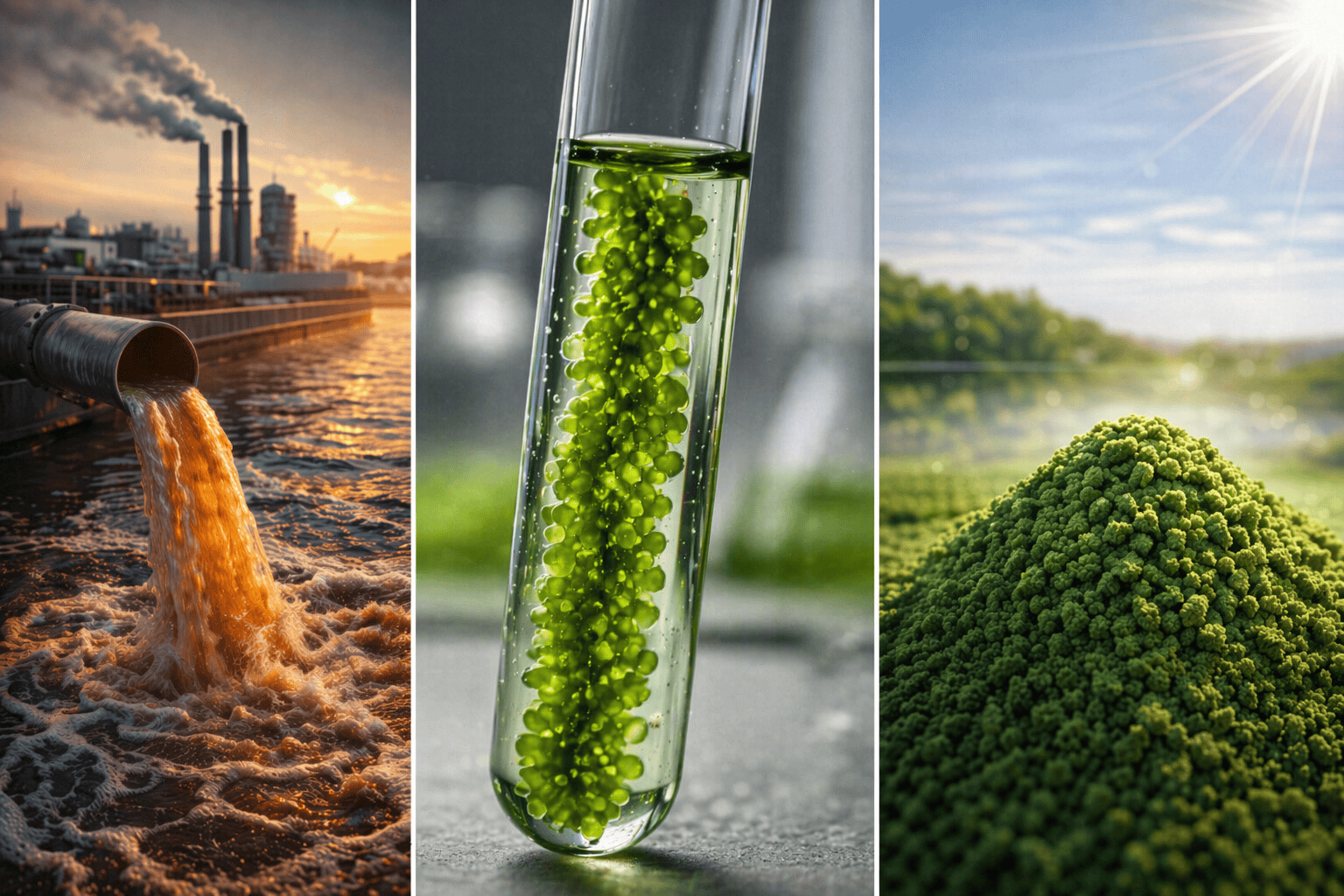
The bioeconomy is often framed in terms of big ideas: circularity, substitution and regeneration. But its real potential emerges when it addresses concrete industrial challenges. Through its microalgae-based wastewater treatment model, Zéni is exploring a different approach: what if wastewater could become more than just a treatment cost? What if it could become a valuable resource?
The Bioeconomy Starts with a New Perspective on Industrial Flows
The bioeconomy is often presented as a shift in raw materials: replacing fossil-based resources with bio-based alternatives, rethinking production methods and making better use of biological resources. All of this matters, but it only tells part of the story.
Sometimes, the bioeconomy starts much further upstream, with a less obvious shift: changing how we view industrial flows. When wastewater is seen solely as something to dispose of, it remains a liability to be managed. It must be treated, brought into regulatory compliance and discharged. The issue is framed as technical, regulatory and financial rather than strategic.
Zéni’s approach challenges that mindset. The company starts not just with an environmental concern, but with a very real industrial problem. Across the food-processing sector, regulations are tightening, treatment costs are rising, sludge is accumulating, chemical treatments are becoming less effective, and water is increasingly scarce.
This raises a different question: what if wastewater could be more than something to dispose of? What if it could be turned into a resource?
This is where the bioeconomy moves beyond broad ambitions and becomes an operational proposition. The goal is no longer simply to reduce environmental impact, but to create value from biological flows.
As Jean-Michel Pommet, Founder and CEO of Zéni, puts it: “In the water sector, everything is generally seen as a cost. What interests us is creating value.”
Microalgae Turn Pollution Control into Resource Recovery
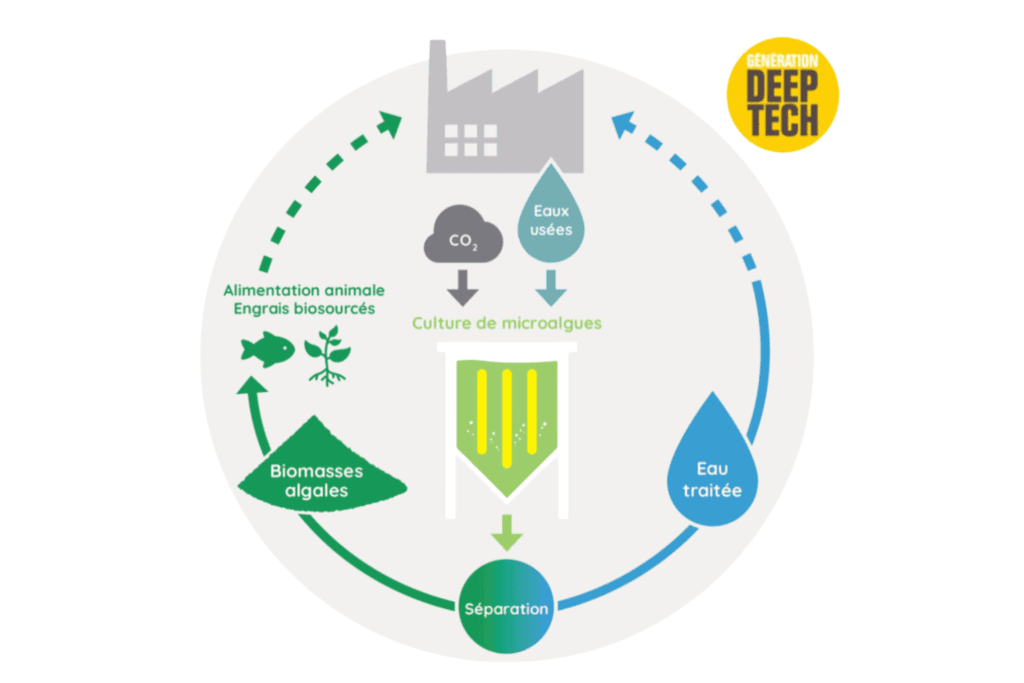
This shift lies at the heart of Zéni’s model. Conventional wastewater treatment focuses on removing, transforming or concentrating unwanted substances such as nitrogen, phosphorus, organic matter and dissolved residues. Zéni takes a different approach: its microalgae do more than purify water. They capture nutrients and convert them into biomass.
That distinction matters. The objective is no longer just to meet discharge standards, but also to preserve the value contained in the wastewater itself.
While conventional processes can generate sludge that needs to be managed, concentrated residues requiring further treatment or environmental impacts that are simply displaced, Zéni is exploring another approach: using biological processes not just to remove pollutants, but to transform them into something useful.
This is what gives the model its bioeconomic dimension. Wastewater treatment becomes more than a pollution-control process. It becomes a form of resource recovery.
On the one hand, the process improves water quality, potentially making reuse possible depending on the application. Initial uses could include cleaning loading bays, washing trucks and other non-critical industrial operations.
This is no small advantage. As drought restrictions increasingly threaten business continuity, the ability to reuse water becomes a significant economic consideration.
On the other hand, the resulting biomass is not treated as a secondary waste product, but as a resource with further commercial potential. Possible applications include agriculture, fertilisation and biostimulation, with animal nutrition representing a potential longer-term opportunity.
As Mr Pommet emphasises: “We are not creating another waste stream. We are producing biomass that can be put to further use.”
The Business Case Comes Before the Environmental Benefits
This is often the missing piece in discussions about the bioeconomy. There is plenty of talk about environmental impact, circularity and the value of living systems, but much less about the underlying economics.
In Zéni’s case, however, the business value comes first. Industrial companies do not invest in an appealing narrative. They invest in solutions to real problems.
Those problems vary: persistent regulatory non-compliance despite significant investment, rising treatment fees, difficult-to-manage sludge, reliance on chemical inputs, water scarcity, exposure to drought restrictions or difficulties handling concentrated residues from other treatment processes.
The underlying issue is the same: wastewater treatment is often a costly operational burden.
Zéni’s proposition goes beyond offering an alternative treatment process. It aims to shift wastewater management from a cost centre towards a combination of tangible benefits:
● regulatory compliance;
● opportunities for water reuse;
● reduced reliance on certain chemical inputs;
● biomass recovery and valorisation.
The food-processing sector is a particularly good example. Its wastewater often contains high concentrations of nutrients that are precisely what microalgae need to grow. This means the process can become more than an additional treatment technology: it has the potential to become part of a broader industrial value chain.
In other words, the bioeconomy here is not an abstract vision of circularity. It is about connecting industrial priorities that are usually managed separately: securing operations, treating wastewater, recovering resources and reusing water.
The Real Challenge: Building a Value Chain That Reaches the Market
On paper, the model is compelling. In practice, it still needs to prove that it can operate reliably over time and at scale. This is precisely what makes Zéni’s case interesting: it highlights the practical challenges that bioeconomic models must overcome.
The first is industrial integration.
Using microalgae for wastewater treatment is nothing new. The challenge is adapting the technology to real industrial conditions: limited space, treatment speed, process reliability, fluctuating wastewater flows and integration into existing facilities.
The question is not simply whether the technology works. It is whether it works here, under these conditions, at these volumes and at a competitive cost.
The second challenge is scaling up.
Zéni’s approach follows a gradual process: analysing wastewater, selecting suitable microalgae strains, testing and monitoring them on site, collecting performance data and then designing a larger treatment unit.
This is an important point. Bioeconomic solutions rarely emerge as ready-made, turnkey systems. They need to be developed, tested and fine-tuned before they can be deployed at scale.
The third challenge, and perhaps the most decisive, is downstream valorisation.
Producing biomass is not the same as creating a market for it. The material must be characterised, stabilised, formulated and standardised. Potential customers need to be convinced, commercial outlets secured and its chemical composition made consistent enough to meet the requirements of existing supply chains.
Mr Pommet identifies this as a key obstacle: “The main challenge today is standardising the biomass so that it can be readily marketed.”
This is where many projects succeed or fail. There is little value in claiming circularity if the material produced cannot find a viable place in the market.
What Zéni’s Case Reveals About the Bioeconomy Today
Zéni’s approach offers lessons that extend well beyond the company itself.
It shows that the bioeconomy is neither a marketing narrative nor simply another name for green innovation. It becomes meaningful when it tackles real industrial constraints, works within the realities of production and creates value while meeting regulatory and market requirements.
Its real potential lies in testing a simple but challenging idea: what we consider waste today could become the starting point for an entirely new production model.
In Zéni’s case, that model depends on three conditions:
● the treated water must meet the required quality standards;
● the biomass must be stable enough to become a commercially viable resource;
● the overall process must remain economically and technically viable within an industrial setting.
This is what makes the subject particularly relevant to entrepreneurs and innovators. The bioeconomy is not just a vision. It is a practical approach to transforming industrial flows.
It challenges businesses to rethink what they discharge, what they measure, what they recover and what they too readily accept as an unavoidable cost.
Jean-Michel Pommet captures this ambition in a simple but telling statement: “The point is not just to treat the water. It is to achieve a level of quality that makes reuse possible.”
What makes Zéni’s case interesting is not the promise of perfect circularity, but the deeper shift it represents. Wastewater is no longer simply something to be treated and safely discharged. It becomes an opportunity to rethink and reorganise an entire value chain.
That is where the bioeconomy becomes tangible: not in abstract discussions about the value of nature, but in a very practical question:
Under what conditions can an industrial waste stream become an economically viable resource, integrate into existing industrial processes and create value for other sectors?
Author: Théo Sainte-Marie
Date: 19 April 2026